 SEEPLORE
Why is an atomic bomb so powerful? Gunpowder burns as fire spreads from grain to grain, but an atomic bomb gets its power from something tiny splitting apart at the very center of an atom. In this post we follow a nuclear explosion in the order things happen, from the first split at one hundred-millionth of a second to the fireball and blast wave a few seconds later. All the numbers are rough values calculated for a bomb the size of the one dropped on Hiroshima in 1945 (15 kilotons).
A uranium nucleus barely holds together
Zoom into a pencil lead far enough and you reach carbon atoms, and at the center of each atom is a nucleus. The nucleus is a clump of even smaller balls: protons, which carry a + charge, and neutrons, which carry none. A uranium-235 nucleus packs 92 protons and 143 neutrons — 235 in all.
That many balls causes a problem. Protons all carry the same + charge, so they push each other apart. The nucleus stays together only because balls that touch grab each other with a much stronger force — but that force vanishes as soon as they move slightly apart. It's like Velcro: it only sticks when it touches. So in a big nucleus, the balls at opposite ends can't hold on to each other, and the whole thing barely holds together.
One neutron in, and it splits in two
Now a single neutron flies in and lodges in the nucleus. With no charge, it isn't pushed away and slips right in. The shaky nucleus wobbles like a water drop, stretches out, pinches in the middle and splits in two. That's nuclear fission. On screen it breaks into two pieces, barium and krypton, and three neutrons fly out.
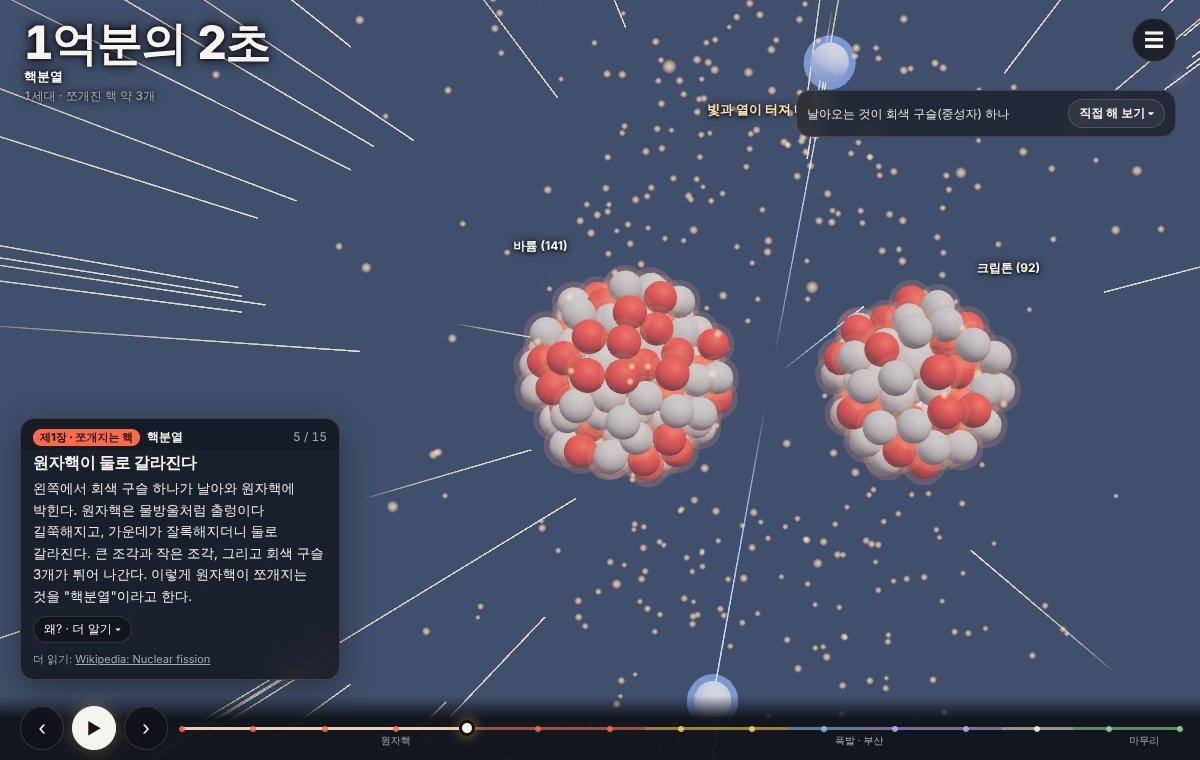
Here's the strange part. Put the before and after on a scale and the number of balls is the same, 236. Yet the pieces are lighter by about 1/1,300. That missing mass didn't vanish — it turned into light and heat. This is what Einstein's E = mc² is about: a tiny amount of mass becomes an enormous amount of energy.
Doubling 81 times in a millionth of a second
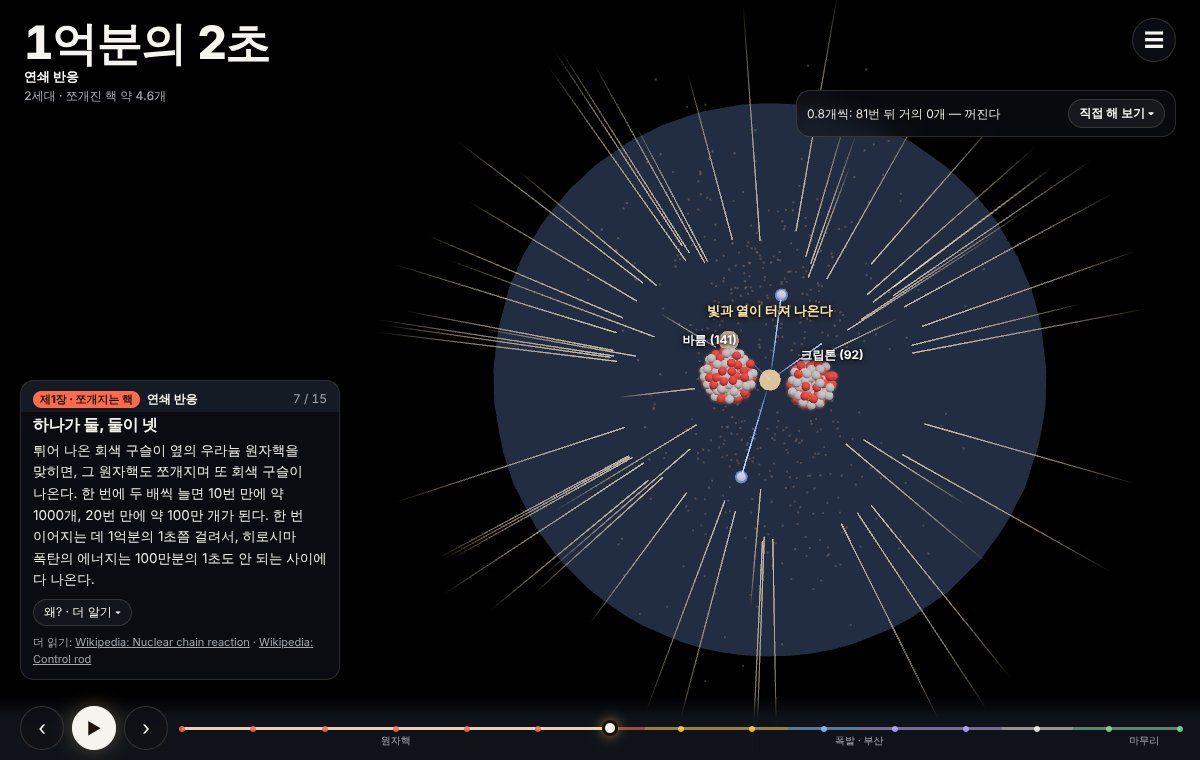
When a flying neutron hits a neighboring uranium nucleus, that one splits too and releases more neutrons. If the number doubles each time, 10 rounds give about 1,000 splits and 20 rounds about a million. It's the same math as folding a sheet of paper in half again and again until it's impossibly thick.
Each round takes about a hundred-millionth of a second. In the Hiroshima bomb it went on for about 81 rounds, and all the energy came out in less than a millionth of a second. This runaway growth is called a chain reaction.
A fireball in one second, a blast wave three seconds later
The instant the chain reaction ends, the energy of the split pieces heats the surrounding air to tens of millions of degrees. That blinding ball of air is the fireball, and within about a second it grows to some 414 m across. All the missing mass added together comes to only about 0.7 g — about the weight of a Korean 1-won coin — yet it releases as much energy as 15,000 tonnes of TNT.
The fireball's light arrives before any sound. On a clear day, anyone in its direct light within about 1.9 km gets burns deep into the skin. Next, the air the fireball shoved aside becomes a wall of pressure — the blast wave — and spreads out. In about 3 seconds it reaches 1.2 km, knocking down most houses inside that circle, and in about 8 seconds it reaches 3.0 km, shattering windows.
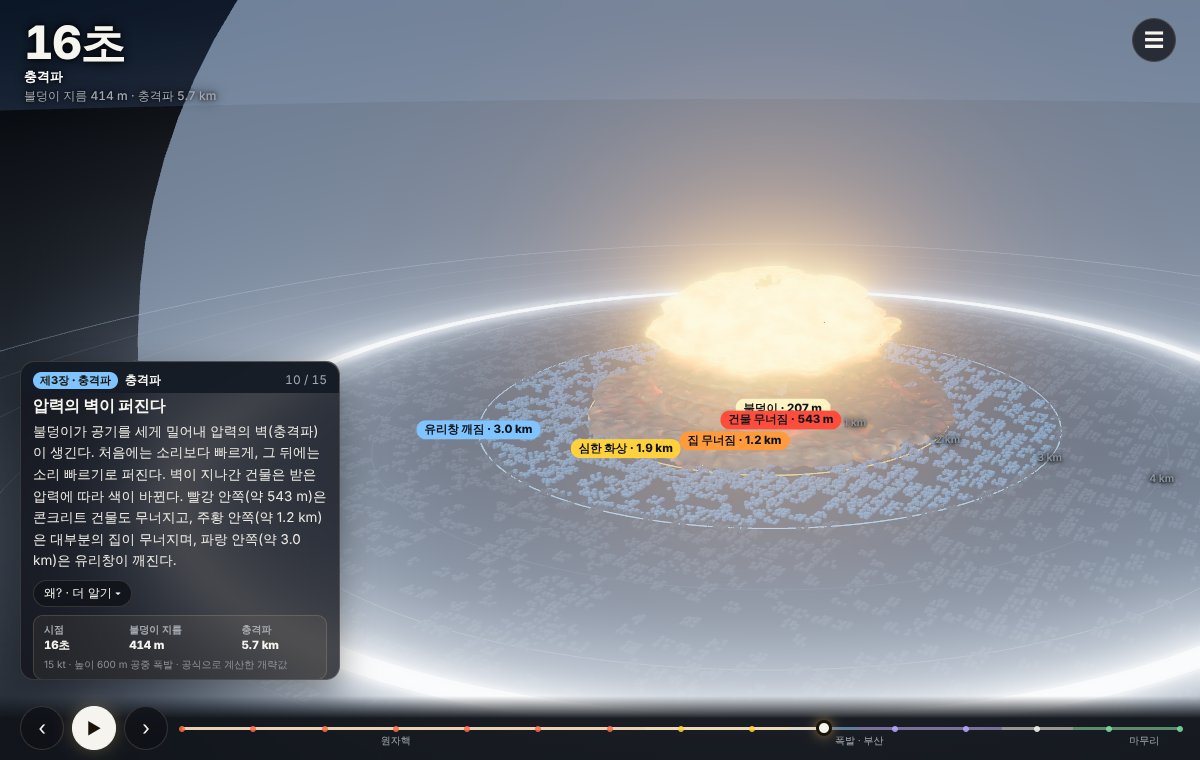
After that, the hot air rises and within minutes forms a mushroom cloud about 11 km high, and radioactive dust inside it — fallout — drifts down with the wind. These distances come from formulas built on test records, so real ones change with the weather and the shape of the land.
What would it look like near home?
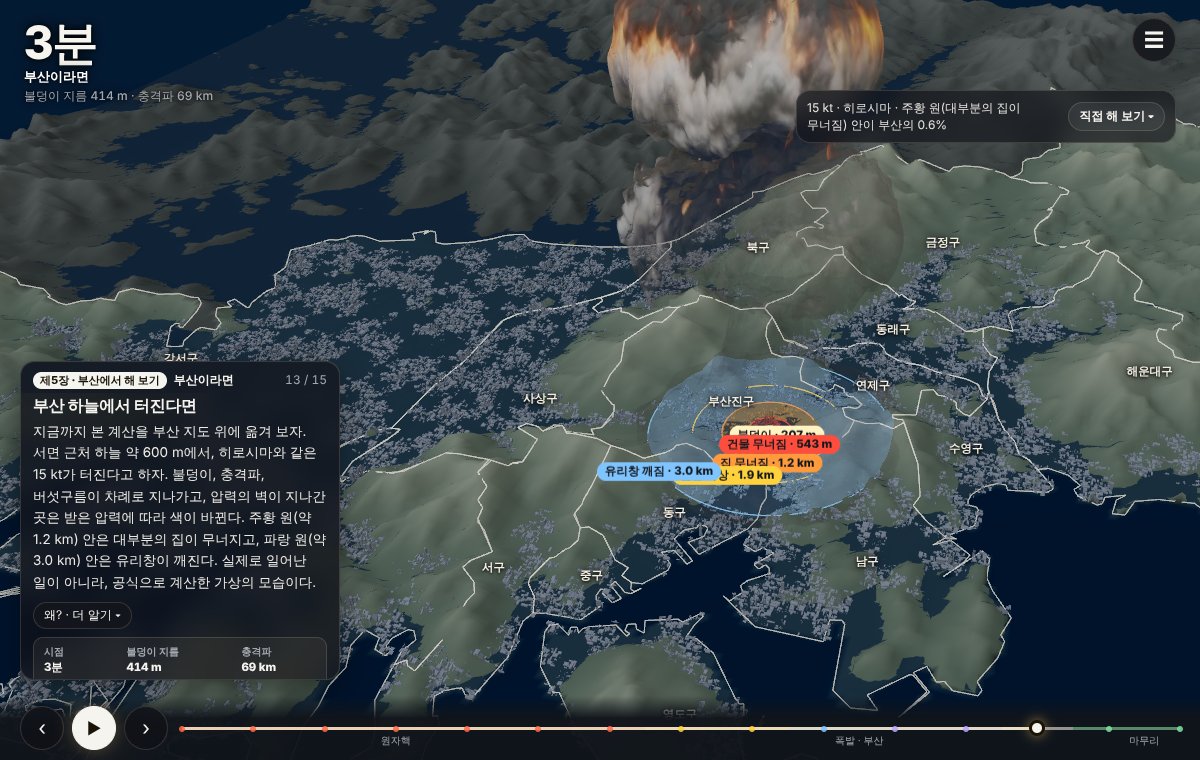
A number like 1.2 km is hard to picture. The last chapter of From Atom to Nuclear Blast puts the same calculation on a map of Busan, a big port city in Korea. Assume the same bomb goes off about 600 m above the city center, and the damage rings are drawn over the real district boundaries. It's an imaginary scenario calculated from formulas — it doesn't account for hills blocking the blast or for people taking shelter.
The same power of the nucleus, tamed so that "one split causes only one more," makes electricity in nuclear power plants, and in hospitals it treats cancer. Only the speed is different. That's why what we use it for matters so much. To drag the time axis yourself from a hundred-millionth of a second to the mushroom cloud, open From Atom to Nuclear Blast. And if you like following one axis from the very small to the very large, Dangerous Space lines up space threats from asteroids to black holes by distance.